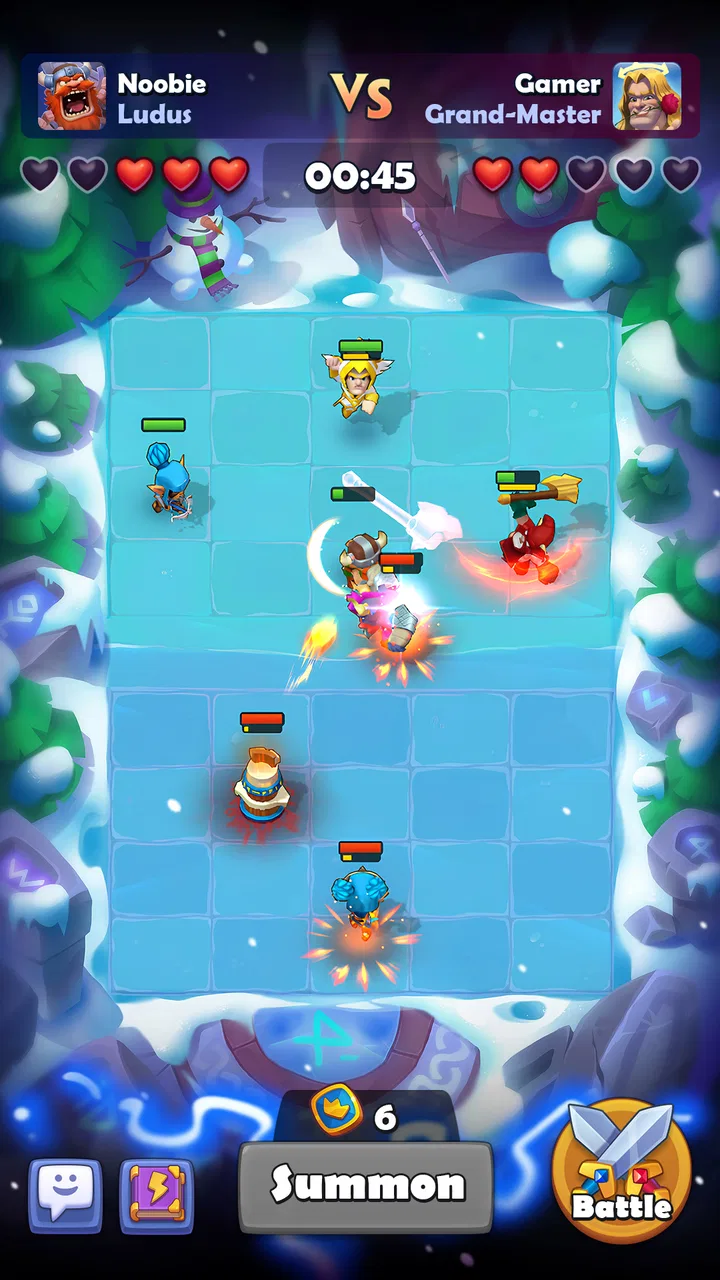
LUDUS・PvP Merge Battle Game
- 4.4
- Rating
- 5.00M
- Installs
- Free
- Price

 Analysis by App-foxy
I went into LUDUS expecting a quick mobile strategy game, and that is exactly where it makes the strongest impression: matches are short enough to fit into a spare moment, but the decisions arrive quickly enough to keep me involved. It combines real-time player-versus-player duels with merging and card-based tactics, so I am constantly choosing between improving what is already on the board and preparing for the next exchange. The result is more thoughtful than a simple tap-and-watch battler, although it also asks me to accept a fair amount of pressure and unpredictability.
Developed by TOP APP GAMES LTD, this free strategy game is aimed at players who enjoy competitive mobile sessions without committing to a long campaign. Its age rating is Everyone 10+, and it runs on Android devices using version 7.0 or later. The game has built a substantial audience, with over five million installs, a 4.5 average from around 217 thousand ratings, and roughly 2.8 thousand written reviews. Those figures do not replace personal experience, but they do match my impression that LUDUS is easy to start and difficult to master.
How the battles feel after the first few matches
The opening experience is deliberately direct. I am not asked to learn a huge world or read through a long story before playing. The focus is on assembling a useful team, understanding how the cards interact, and reacting while the duel develops in real time. That clarity is one of the game's best qualities. I can usually understand why a round went well or badly, even when the outcome is disappointing.
You May Also Like

 Blood Strike: 2.5 Anniversary
Blood Strike’s Loadouts Turn Every Drop Into a Tactical Gamble
A close look at Blood Strike’s custom loadouts: how fast access to signature weapons reshapes its battle royale rhythm, rewards preparation, and narrows the gap between fights.

 Pandora - Music & Podcasts
Pandora’s Music Is Easy to Start, but Harder to Recover
Pandora’s strength is its low-effort path from a seed to a station. Its weak spot is how much confidence it asks you to place in connection, setup, and quiet recovery.

 8 Ball Pool
 Is Built on Rivalries, Rematches, and Routine
A close look at the rivalries, rematches, shared routines, and unanswered safety questions that turn a quick pool match into a persistent mobile community.

 Samsung Music
’s Quiet Strength Is Playing What You Already Own
Its reach comes less from spectacle than from dependable access to a personal library. That simplicity is both the app’s strongest retention engine and its ceiling.

 AccuWeather: Weather Radar
AccuWeather Review: A Quick, Clear Forecast for Everyday Decisions
For everyday plans, the best forecast is the one you can understand quickly. AccuWeather makes rain timing, radar, and local conditions easy to act on, with a few trade-offs.

 Hill Climb Racing
Why Hill Climb Racing Still Turns Crashes Into One More Run
A tiny car, a bumpy hill and one more upgrade: Hill Climb Racing keeps resurfacing because its simple chaos makes every near-miss feel personal.
More From Our News Desk



The merge element gives each match its central rhythm. Instead of treating every unit as a permanent piece, I look for opportunities to combine compatible pieces and turn a crowded board into something stronger. The obvious temptation is to merge immediately, but that is not always the smart move. Sometimes keeping two separate units gives me better coverage, while a premature combination can leave a gap at exactly the wrong moment.
That trade-off is where the strategy becomes more interesting than the store summary suggests. I am not simply collecting the biggest possible pieces. I am managing timing, board space, and the risk of losing a useful position. A merge can improve one part of my setup while reducing flexibility elsewhere. When I win because I delayed a combination and waited for a better arrangement, the victory feels earned rather than automatic.
The card-battle side adds another layer of planning. Cards give the duel a sense of preparation, while the live format prevents me from calmly solving every situation at my own pace. I have to recognize what is happening and commit before the opponent's pressure becomes impossible to answer. This makes the game satisfying for players who enjoy tactical decisions under a clock, but less comfortable for anyone who prefers relaxed, turn-based planning.
Why the merge system is more than a visual upgrade
My most useful lesson was to stop viewing merges as simple upgrades. The right combination depends on what the rest of the board is doing. If one lane or area is already stable, strengthening it may be less valuable than preserving options in a weaker position. I also found that a tidy-looking board is not automatically an efficient one. A slightly messy arrangement can be strategically better if it leaves room to respond.
This is an important distinction from many casual puzzle games. In those games, combining pieces often feels like a reward with little downside. Here, every merge can change the shape of the battle. I need to think about what I am giving up, not only what I am gaining. That makes even familiar-looking actions meaningful, especially when the opponent is applying pressure at the same time.
Another practical habit is to watch the tempo of the whole duel rather than focusing on one successful exchange. A strong move may still be wrong if it consumes the flexibility needed a few moments later. I get better results when I prepare a sequence of likely responses instead of chasing the most impressive immediate improvement. This is the kind of small adjustment that separates a beginner's play from a more deliberate approach.
Where the card strategy helps and where it can frustrate
The card element gives me a reason to think beyond the current board. I am encouraged to consider how a choice affects the next phase, not just whether it looks powerful now. That makes the game feel closer to a compact strategy duel than to an idle battle screen. The best matches involve a constant exchange between planning and adaptation.
At the same time, card-driven competition can make losses feel less transparent than they would in a purely tactical board game. Even when I make sensible decisions, the available options may not line up perfectly with the situation. That uncertainty is part of the design, but it means I cannot always treat a defeat as proof that one specific move was wrong. I have to separate poor decision-making from an unfavorable sequence and avoid changing my entire approach after one frustrating match.
For that reason, I recommend judging progress over several sessions rather than after a single duel. The game rewards learning patterns: when to combine, when to hold, and when to accept a small setback to protect the next opportunity. Players who enjoy that kind of gradual improvement will find more depth here than someone looking only for immediate, predictable results.
What makes LUDUS stand out in everyday play
The strongest evidence in its favor is how naturally it fits into small gaps in the day. I can play a match while waiting for an appointment or taking a short break, then put the phone away without needing to remember a long narrative thread. Yet the session does not feel empty. There is enough decision-making to make a win satisfying, and enough variation in the battle flow to keep repeated matches from becoming identical.
A realistic example is a commute with a few spare minutes. I might begin a duel expecting to play casually, notice that my first arrangement is not working, and adjust by preserving a key piece instead of merging it. If the match ends before I arrive, I have still had a complete experience rather than stopping in the middle of a campaign mission. That convenience is a genuine strength for mobile players who want competition in compact portions.
The real-time format also gives victories a social edge, even without needing a long conversation with another player. I am responding to a living opponent rather than following a fixed sequence. That makes a clever recovery especially memorable. A scripted computer challenge can be enjoyable, but it rarely creates the same feeling of having adapted to another person's pressure.
Compared with conventional turn-based strategy games, LUDUS is faster and less forgiving of hesitation. A turn-based alternative is better if I want to calculate every possibility, pause freely, or play while distracted. Compared with an action-heavy arena game, however, LUDUS puts more emphasis on setup and choices than on reflexes. I still need to react promptly, but the important work often happens in how I arrange and improve my side of the battle.
It also differs from traditional collectible card games in the way the battlefield remains active while I make decisions. A deck-building specialist may offer more room for long-term construction and detailed card theory, while this game delivers a more immediate loop. I would choose LUDUS when I want the card element to matter inside a quick duel, not when I am looking for an elaborate tabletop-style simulation.
Small decisions that improve the learning curve
My first recommendation is to treat early matches as experiments rather than tests of personal skill. Try one approach that favors quick merges, then compare it with a more conservative arrangement. The point is not to find a universal answer, because the better choice depends on the developing board. This simple comparison makes the game's cause and effect easier to understand.
Second, avoid spending every useful option as soon as it appears. Holding a piece or card can feel passive, but preserving a response is often more valuable than creating a small immediate advantage. I especially noticed this when the board was crowded. A little patience kept me from locking myself into an arrangement that looked strong but had no room to adapt.
Third, review the moment the match changed direction. Instead of asking only why I lost, I ask when my choices became narrower. Was it an unnecessary merge, an overcommitment to one side, or a failure to prepare for pressure? This method turns a quick mobile game into a surprisingly effective exercise in recognizing opportunity cost.
Finally, I would not measure enjoyment solely by the win rate. The game is most rewarding when I can see a better decision forming, even if the match still goes against me. That mindset matters because real-time competitive systems can become tiring when every loss feels like wasted time. LUDUS works better when I treat each duel as a short lesson as well as a contest.
The main weakness is the pressure built into its format
The same immediacy that makes the game convenient can also become its biggest limitation. Real-time duels do not leave much room for interruption. If I am playing while distracted, switching tasks, or dealing with a poor connection, a few missed moments can damage the entire position. This is not the right choice for someone who wants a strategy game that can be paused whenever life gets in the way.
The merge system may also feel frustrating before its logic becomes familiar. A new player can see an obvious combination and assume it must be correct, only to discover that the resulting board is less useful. The game does not become unfair because of that, but it does demand a willingness to learn through mistakes. Players who prefer clear, deterministic puzzles may find the live competitive setting less comfortable.
There is also a natural tension between free access and optional spending. LUDUS is free to download, while its in-app purchases range from $0.49 to $119.99 per item. That range matters when deciding how to approach the game. I would recommend treating purchases as optional support rather than as part of the basic learning process. Spending early can make progression feel faster, but it does not replace understanding when to merge or how to protect flexibility.
For younger players, the Everyone 10+ rating is worth taking seriously in the practical sense that competitive pressure and in-app purchases should be discussed at home. The game can be suitable for a family audience, but suitability is not the same as unlimited access. I would use the device's purchase controls and agree on boundaries before handing it to a child.
Another limitation is that the game's appeal depends heavily on enjoying repeated competitive rounds. If I want a rich story, a large exploration map, or a slow campaign with carefully staged discoveries, this is not the better option. Its identity is built around the duel itself. That focus is refreshing when I want a quick contest, but narrow when I am looking for a broader adventure.
Who should install it and who should skip it
I think LUDUS is a strong fit for players who like compact strategy games with immediate consequences. It suits someone who enjoys experimenting with combinations, learning from losses, and making decisions while the board remains active. It is also a good choice for a player moving from casual puzzle games toward more competitive systems, because the merge mechanic provides an accessible entry point before the deeper tactical habits develop.
It is less suitable for players who dislike pressure, unpredictable battle flow, or the possibility that a sensible plan may need to change quickly. I would also steer away from it if your main goal is a relaxing game for multitasking. The short session length may look convenient, but the live format still expects attention during the important moments.
Players who already spend most of their time with complex deck-builders may find the strategic scope more compact than they prefer. In that case, a deeper card game could offer more long-term construction and theory. LUDUS is better understood as a focused middle ground: more involved than a basic merge game, but quicker and more immediately readable than a full-scale strategy hobby.
The current version is 1.29.6, and the game's established player base suggests that it is not an obscure experiment with no competitive activity around it. Still, I would install it for the style of play rather than for the size of its audience. Popularity is useful reassurance, but the deciding question is whether real-time merging and card tactics sound enjoyable to you.
My verdict after putting the pieces together
LUDUS is at its best when treated as a fast tactical duel, not as a passive collection game. Its strongest idea is the way merging creates both power and risk. I am constantly weighing an immediate improvement against the flexibility I may need later, and the live opponent gives those choices real urgency. That combination makes the game easy to pick up while leaving room for genuine improvement.
I would recommend it to Android players on compatible devices who want a free strategy game for short, focused sessions. The 5M+ install milestone, 4.5 average rating, and broad rating volume show that many players have found the format appealing, but my recommendation rests more on the quality of its central decision loop. When I have a few uninterrupted minutes and want something more engaging than an idle distraction, it gives me a clear reason to keep playing.
I would not recommend it to someone seeking a pause-friendly strategy experience, a story-driven game, or a completely predictable puzzle. The real-time structure can punish divided attention, and optional purchases require sensible boundaries. Those are meaningful caveats, not minor details.
Overall, TOP APP GAMES LTD has made a focused competitive game with a useful balance between accessibility and tactical depth. I like that a single merge can solve one problem while creating another, because it keeps the board alive with possibilities. If that kind of trade-off sounds appealing, LUDUS is worth trying for free; if you prefer slow planning without pressure, a turn-based alternative will probably serve you better.
FAQs for LUDUS・PvP Merge Battle Game
01What is the main objective of LUDUS・Strategy PvP Battle Game?
LUDUS is a strategy-based PvP battle game where players aim to build and command their armies to defeat opponents in real-time matches. The main objective is to strategically outmaneuver and outsmart opponents using a variety of units, each with unique abilities and strengths, while capturing key territories on the battlefield.
02Is LUDUS free to play, and are there in-app purchases?
Yes, LUDUS is free to download and play. However, it offers in-app purchases that can enhance gameplay. Players can buy items such as additional units, special abilities, and aesthetic customizations. While these purchases can provide advantages, they are not necessary to enjoy or progress in the game.
03What are the system requirements for LUDUS on Android and iOS devices?
For Android, LUDUS requires at least Android 7.0 or higher and a minimum of 2GB RAM for optimal performance. On iOS, the game requires iOS 12.0 or later and is compatible with iPhone, iPad, and iPod touch. Ensure your device meets these requirements to enjoy a seamless gaming experience.
04Does LUDUS support multiplayer modes, and how do I connect with friends?
Yes, LUDUS supports multiplayer modes, allowing you to battle against friends and other players globally. You can connect with friends by linking your game account to social media platforms or by sharing your unique friend code. This feature promotes competitive play and social interaction within the game.
05Are there any tips for beginners to succeed in LUDUS・Strategy PvP Battle Game?
For beginners, understanding the strengths and weaknesses of different units is crucial. Start by familiarizing yourself with basic units and gradually experiment with advanced ones as you progress. Managing resources effectively and anticipating opponents' moves are key strategies. Engaging in practice matches can significantly improve your skills and strategic thinking.
Pros
- Engaging real-time strategy matches.
- Wide variety of units and tactics.
- Intuitive controls and interface.
- Regular updates with new content.
- Strong community and competitive play.
Cons
- Requires constant internet connection.
- In-app purchases can be pricey.
- Steep learning curve for beginners.
- Occasional matchmaking imbalances.
- Battery consumption is quite high.

LUDUS・PvP Merge Battle Game
Gallery